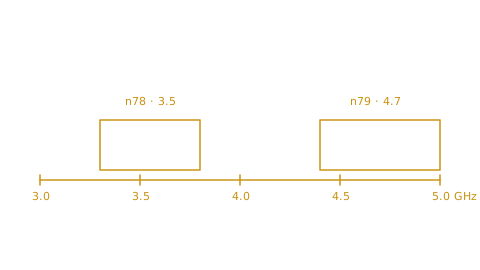
Two weekends of drive-testing across two dense-urban neighbourhoods later, we have a fairly clear answer to a question we hear often: when should an operator choose n79 over n78 in an urban core deployment? The short version: it depends on what's between the user and the antenna more than on anything else.
The setup. We instrumented two SUVs with calibrated UE simulators capable of camping on either band, GPS, and a logger that recorded RSRP, RSRQ, SINR, and achieved throughput at 1 Hz. We drove a fixed 18 km loop covering two neighbourhoods — call them Zone Alpha (mid-rise reinforced concrete, narrow streets, mixed-use) and Zone Bravo (1990s-era residential blocks with thicker walls and wider streets). We did the loop on n78 (3.5 GHz) and again on n79 (4.7 GHz) under near-identical traffic conditions.
The outdoor results are the predictable part. n79's higher frequency gave us roughly 3.4 dB more usable throughput in line-of-sight outdoor spots, on the order of what the link-budget calculator predicted. Free-space path loss obviously favours n78, but the wider channel and the better antenna gain at n79 frequencies offset that. For a user standing on a balcony or walking a wide street, n79 wins.
Outdoor: n79 wins by 3.4 dB. Indoor through reinforced concrete: n78 wins by 9 dB. Pick your enemy.
The indoor results are where it gets interesting. We took the simulators inside two different buildings — a mid-rise concrete office and a 1980s residential block — and measured at the perimeter, halfway in, and the deepest interior spot. n78 punches through walls dramatically better. Building-penetration loss at 4.7 GHz exceeded 9 dB compared to 3.5 GHz in our deepest measurements, which is enough to flip the result completely.
The practical answer is the boring one. If your traffic profile skews indoor — residential, office, retail — give n78 priority and treat n79 as outdoor relief. If you're covering open public spaces, transit nodes, or patios, n79's wider channel and better antenna pattern are real advantages. Don't deploy one and not the other in dense urban cores; you need both.
Three takeaways:
Building-penetration loss dominates the choice. Free-space numbers are correct but mostly irrelevant in cities. Walls are the variable that decides which band wins.
Drive tests need calibrated UE. Phone-based measurements gave us inconsistent enough results that we couldn't draw conclusions from them. The calibrated simulators were worth the rental fee.
Mixed deployment is not a luxury. Operators who only deploy one of the two bands in a dense core will leave persistent dead zones in the other propagation regime.
Subscribe at edgesignal.example for next month's drive-test methodology series.